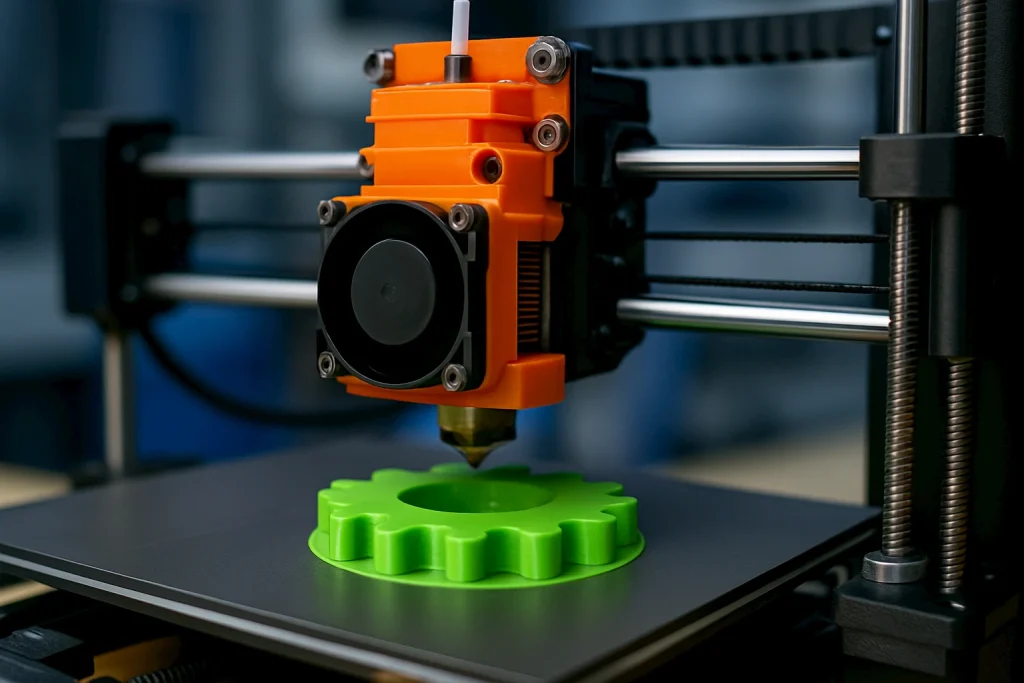
3D printing, commonly referred to as additive manufacturing, creates physical objects by building material layer by layer from a digital file. Unlike traditional manufacturing methods that remove material through cutting or milling, additive manufacturing deposits material only where required.
This approach allows for greater design freedom, reduced waste, and faster production cycles. Designers and engineers use 3D printing to move from concept to physical form without investing in expensive tooling or molds.
3D printing supports a wide range of applications, from early stage prototypes to functional components and finished products. Materials vary by process and may include plastics, resins, and specialized composites.
3D printing continues gaining adoption because it solves several challenges associated with traditional manufacturing. Speed, flexibility, and efficiency make additive manufacturing valuable across industries.
Rapid iteration allows teams to test form and function early in the design process. Physical prototypes reveal issues that digital models may not capture, which reduces costly revisions later.
Complex geometries that prove difficult or impossible to manufacture traditionally become achievable through additive processes. Internal structures, organic shapes, and intricate features no longer require simplified compromises.
Material efficiency also improves sustainability. Because material is added rather than removed, waste decreases and production becomes more resource conscious.
Prototyping represents one of the most common uses of 3D printing. Product developers rely on rapid turnaround to validate ideas, test ergonomics, and confirm fit before committing to full production.
3D printing shortens development timelines from weeks to days. Designers iterate quickly, adjust designs based on physical feedback, and refine performance before scaling.
This process benefits startups, research teams, and established manufacturers alike by reducing risk and improving confidence prior to manufacturing investment.
Customization remains one of the strongest advantages of 3D printing. Each printed object can differ without increasing setup complexity.
Custom parts, personalized components, and unique design variations become practical even at low volumes. Industries such as education, healthcare, art, and product design benefit from this flexibility.
Low volume manufacturing also becomes more cost effective. When traditional tooling costs outweigh production volume, 3D printing offers a practical alternative.
3D printing supports on demand manufacturing by eliminating the need for large inventories. Parts print when needed, which reduces storage requirements and downtime.
Replacement components, jigs, fixtures, and specialty parts can be produced quickly. This approach proves especially valuable when legacy parts become unavailable or discontinued.
On demand production improves responsiveness and operational efficiency across maintenance, repair, and development workflows.
3D printing supports a wide range of use cases across multiple sectors.
Engineering and research teams use printed prototypes to test fit, function, and ergonomics. Architects and designers rely on scale models and presentation pieces to communicate concepts visually.
Artists and makers explore complex forms and small batch creations that traditional fabrication limits. Educational and medical fields use models for instruction, visualization, and demonstration.
Manufacturing environments apply 3D printing for tooling aids, fixtures, and functional components that improve production efficiency.
Material selection plays a significant role in print performance. Strength, flexibility, surface finish, and visual appearance vary based on material type.
Print resolution also affects outcomes. Finer layer heights improve surface smoothness but increase print time and cost. Coarser layers reduce production time but may require additional finishing.
Object orientation and support structures influence both print quality and post processing requirements. Proper planning reduces defects and improves consistency.
Post processing options such as sanding, smoothing, or painting enhance appearance and functionality when required.
Successful 3D printing begins with preparation. Digital files must meet dimensional and structural requirements to print correctly.
Design review ensures proper scale, wall thickness, and geometry. Planning for supports and orientation reduces post processing effort.
Balancing budget, material choice, and turnaround time helps align expectations with outcomes. Clear project goals lead to smoother production and better results.
While 3D printing technology continues advancing, expertise remains critical. Understanding materials, machine capabilities, and design constraints ensures reliable results.
Collaboration between designers and print specialists improves efficiency and reduces failed prints. This collaboration helps optimize files and select appropriate processes.
Experience transforms 3D printing from experimentation into dependable production.
3D printing supports prototyping, custom parts, models, tools, and low-volume production.
Yes. Many materials provide sufficient strength and durability for functional applications.
3D printing often produces parts in days rather than weeks, especially for prototypes and small runs.
Yes. Additive manufacturing uses material only where needed, reducing waste compared to subtractive methods.
Yes. One-off and custom projects represent a core strength of 3D printing.
3D printing in Edmonton continues shaping how ideas move from concept to reality. Additive manufacturing supports rapid development, customization, and efficient production without the constraints of traditional processes.
As industries seek faster innovation and flexible manufacturing solutions, 3D printing remains a practical and proven tool. With proper planning and expertise, additive manufacturing delivers reliable results across prototyping, customization, and on demand production.
3D printing no longer represents experimentation alone. It functions as an established method for creating precise, functional, and meaningful objects across industries.